
“The Mastermind of Energy Dominance”: How Trump’s Heavy-Crude Strategy Secured the US Economy
By Ashish Bhatta ·

Throughout modern economic history, statecraft and monetary hegemony have relied on more than market efficiencies and open trade. To preserve macroeconomic dominance, hyper-powers often weaponize structural leverage—deploying military force, orchestrating extrajudicial interventions, manufacturing diplomatic pretexts, and forming exclusive commercial alliances.
By examining the deliberate execution of kinetic interventions, diplomatic pretexts, and strategic refinery partnerships alongside future projections for **gold** and the **US Dollar (USD)**, a unified thesis emerges: **The US engineered geopolitical instability to lock down global energy margins, secure petrodollar liquidity, and force capital into dollar-denominated assets.**
## 1. The Playbook: War, Abduction, and Manufactured Pretexts

### Phase 1: Kinetic Intervention and Venezuelan Heavy Crude
When a foreign producer attempts to bypass dollar clearing channels or nationalize natural resources, diplomatic narratives are rapidly deployed to delegitimize its state structure.
In Venezuela, accusations of non-compliance, election fraud, and narcoterrorism served as the narrative framework to justify economic blockades, asset freezes, and political interference—culminating in kinetic operations targeting heads of state, including Nicolás Maduro.
- **The Real Asset:** Venezuela controls the Orinoco Belt—the largest extra-heavy crude deposit on Earth. Extra-heavy crude is vital for high-yield middle distillates (diesel, jet fuel, and heating oil).
- **The Economic Takeover:** Removing autonomous sovereign control over this basin allowed Western institutional actors to force heavy crude into controlled, discounted supply corridors.
### Phase 2: Proxy Conflict and Manufactured Crisis in the Middle East
A parallel strategy targeted Iran and the Persian Gulf. Using pretexts of maritime security and regional containment, military confrontations and sanctions were directed at Iranian energy logistics.
- **Friction at the Chokepoints:** Managed escalations near the Strait of Hormuz created structural risk premiums, driving up spot prices for Middle Eastern light-sweet crude.
- **Forced Rerouting:** As state-owned refiners in the Middle East faced direct security risks and supply bottlenecks, global buyers were forced to rely on designated, third-party intermediary hubs.
### Phase 3: Downstream Monopolization via Reliance Industries
Raw crude extraction yields minimal value without specialized downstream refining capacity. To extract maximum yield from heavily discounted Venezuelan crude and volatile Middle Eastern streams, Western energy interests formed mega-refining alliances with private conglomerates, notably Mukesh Ambani’s **Reliance Industries**.
- **Capturing the Crack Spread:** Operating the world's most complex refining nexus at Jamnagar (with an industry-leading Nelson Complexity Index), Reliance was uniquely equipped to process heavy, sour slates at exceptionally low costs.
- **Dollarized Settlement:** By channeling expropriated or discounted crude through Jamnagar, refined petroleum products were re-exported globally and settled exclusively in **US Dollars**. This mechanism effectively neutralized independent state producers while funneling refining margins directly back into the USD financial clearing network.
## 2. Macroeconomic Mechanics: Manipulating Inflation, Rates, and Liquidity
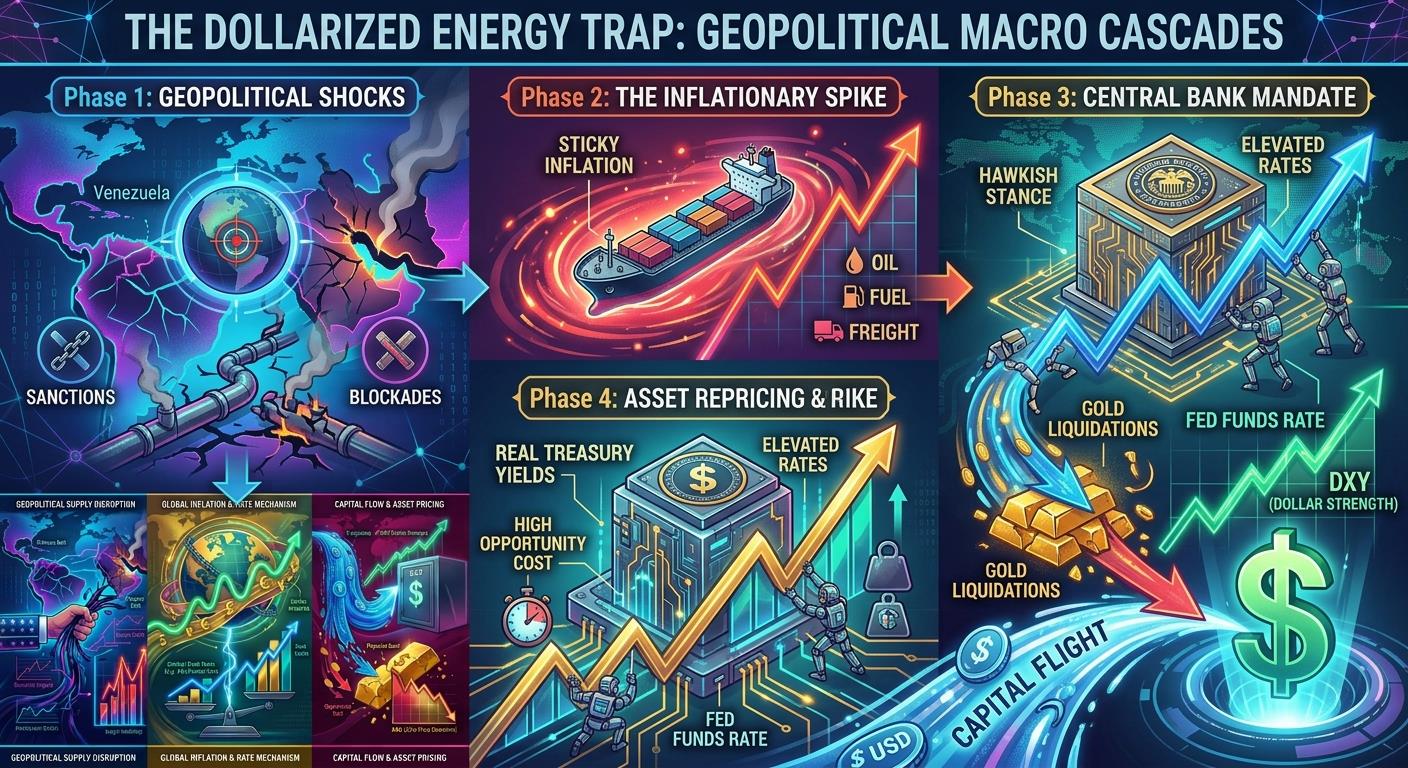
1. **Artificial Energy Inflation:** By disrupting raw energy supplies and forcing them through complex intermediary channels, global input costs remained elevated.
2. **Hawkish Central Bank Response:** Sticky energy-driven inflation left central banks, led by the Federal Reserve, with little room to aggressively cut interest rates, keeping short- and medium-term benchmark yields elevated.
3. **The Yield Trap:** High real bond yields make non-yielding physical gold expensive to carry. Institutional capital shifted out of safe-haven bullion and into yield-bearing US Treasury instruments.
4. **Liquidity Squeezes:** Global institutions facing rising debt service costs were forced to liquidate liquid assets—primarily gold—to fulfill margin calls and secure USD liquidity.
## 3. The Future Outlook: Gold and Dollar Trajectories (2026–2027)
Understanding this structural playbook provides clear perspective on the multi-year trajectory for precious metals and major fiat currencies.
### The US Dollar Index (DXY): High Plateau Before Long-Term Softening
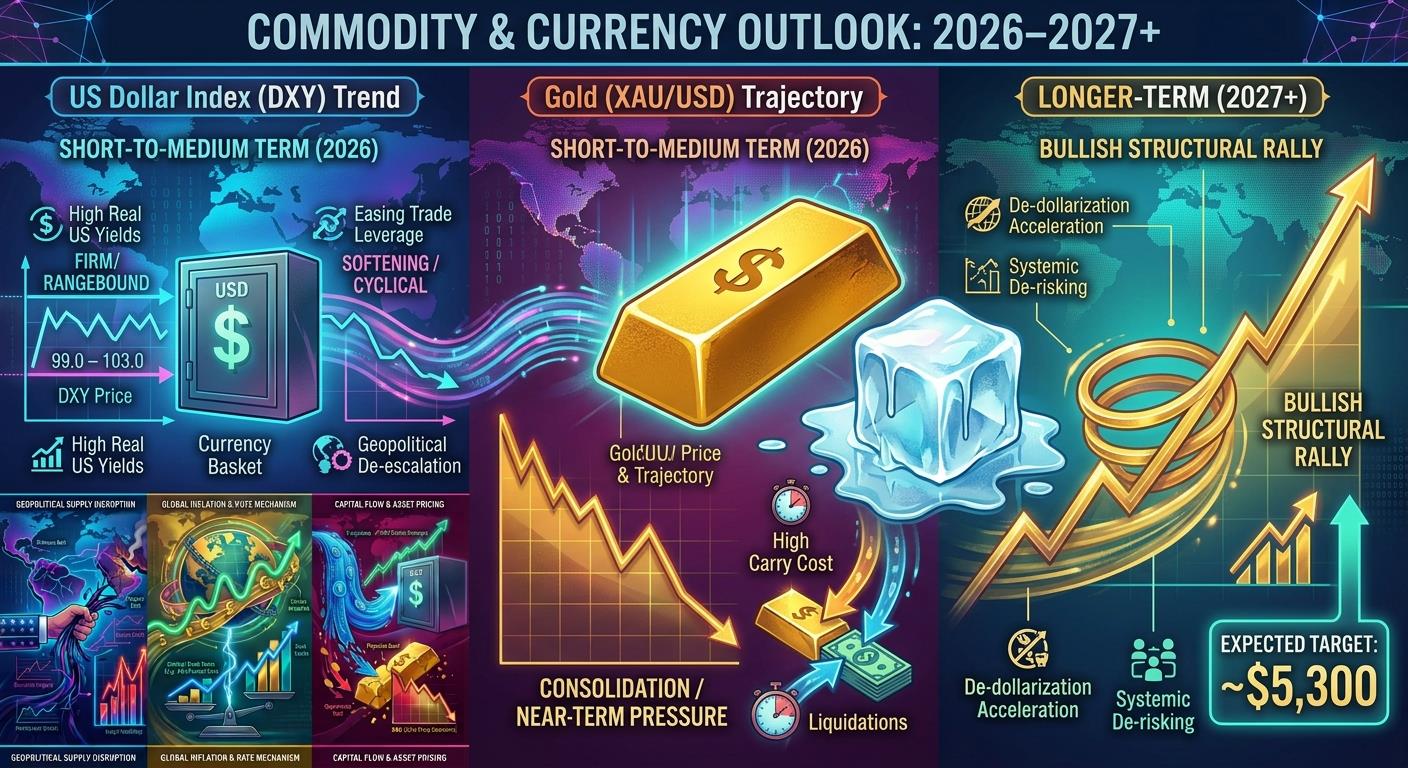
- **Short-to-Medium Term:** The US Dollar Index is expected to remain supported in a firm range (trading roughly between 99.0 and 103.0) due to elevated US Treasury yields and lingering geopolitical risk premiums. Managed high energy costs keep the petrodollar demand loop active, shielding the dollar from immediate sharp declines.
- **Longer-Term Shift:** As high debt servicing costs weigh on domestic fiscal balance sheets and global supply chains adapt to alternative settlement channels, the dollar's yield advantage is expected to gradually narrow, opening the door for long-term currency re-alignments.
### Gold (XAU/USD): From Severe Downturn to Structural Rebound
- **Short-Term Downturn:** In the near term, gold remains vulnerable to elevated opportunity costs and liquidity-driven sell-offs. Analysts have adjusted near-term 2026 averages down toward $4,250–$4,495/oz as markets absorb high real rates.
- **Long-Term Structural Rally (2027 and Beyond):** Once central banks complete their rate-holding cycles and weaponized trade frictions accelerate de-dollarization among non-aligned nations, physical gold is poised for a major rebound. Major institutional forecasts (including J.P. Morgan and Metals Focus) project gold advancing toward average levels of **$4,650 to $5,330/oz** by 2027, with upside potential reaching $6,000/oz as central bank reserve accumulation resumes at scale.
## The Structural Impact on the Nepalese Economy
When global hyper-powers manipulate energy flows through targeted military actions, enforced diplomatic blockades, and concentrated refining monopolies (such as the Reliance Jamnagar pipeline), small, landlocked, import-dependent economies like **Nepal** experience immediate second- and third-order macroeconomic shocks.
Nepal operates under two key macro constraints: a 100% dependency on imported petroleum through the **Nepal Oil Corporation (NOC)** (sourced via Indian Oil Corporation) and a **fixed currency peg** (Nepalese Rupee pegged at 1.6 to the Indian Rupee, which in turn moves with the US Dollar).
Here is how these global shifts directly impact Nepal’s domestic economy:

### 1. Macro Headwinds: Imported Inflation & Reserve Drainage
#### A. Surge in Domestic Fuel and Logistics Costs
As geopolitical friction inflates global crude oil prices and refiners collect high processing margins, the procurement rate sent by Indian Oil Corporation (IOC) to the Nepal Oil Corporation (NOC) rises significantly.
- **Consumer Inflation:** Because all freight and supply chains across Nepal rely on diesel and petrol, higher fuel costs directly drive up retail food, vegetable, construction material, and public transit prices across urban and regional markets.
- **Fiscal Burden on NOC:** The Nepal Oil Corporation frequently incurs massive fortnightly losses absorbing price surges to buffer domestic consumers, straining government balance sheets and forcing periodic price hikes.
#### B. Severe Pressure on the Trade Deficit
Petroleum products rank as Nepal's single largest import line item.
- Higher global crude prices mean Nepal spends a significantly larger share of its convertible foreign exchange reserves just to meet baseline energy needs.
- This widens the national trade deficit, forcing the Nepal Rastra Bank (NRB) to implement tighter import restrictions or macro-prudential liquidity controls to protect national reserves.
### 2. Macro Tailwinds: Remittance Gains & Lower Gold Import Costs
#### A. The Remittance Windfall (Strong USD Dividend)
Nepal's domestic consumption is heavily cushioned by remittance inflows from millions of migrant workers in the Gulf, Malaysia, and Western nations.
- As high US Treasury yields and energy demand drive up the US Dollar Index (DXY), the US Dollar strengthens against regional currencies, including the INR and NPR.
- When Nepali workers send earnings home, every US Dollar converts into **significantly more Nepalese Rupees**. This surge in local-currency liquidity boosts household purchasing power, stimulates local market spending, and sustains domestic economic liquidity during inflation spikes.
#### B. Relief on Gold Imports and Balance of Payments
Gold is both a traditional store of value in Nepal and a significant source of capital drain via legal bullion imports and informal trade.
- The severe downturn in global gold prices (caused by high global real yields and high opportunity costs) lowers the capital outlay required by the Nepal Rastra Bank and commercial banks to import physical gold.
- Domestic bullion prices drop or consolidate during such global sell-offs, reducing total foreign currency outflows for luxury/asset imports and allowing consumers to purchase gold at relatively lower cost points during peak festive and wedding seasons.
### Summary Matrix for Nepal
| Economic Variable | Impact Direction | Primary Transmission Mechanism |
| --- | --- | --- |
| **Retail Inflation (CPI)** | 🔴 Negative (Higher) | Transport & freight costs rise directly with imported fuel rates. |
| **Trade Balance** | 🔴 Negative (Wider Deficit) | Larger foreign exchange drain to cover basic petroleum import bills. |
| **Remittance Cash Flow** | 🟢 Positive (Higher NPR Value) | Strong USD yields higher conversion rates into local Nepalese Rupees. |
| **Foreign Forex Reserves** | 🟡 Mixed / Neutral | High fuel import costs are offset by stronger remittance inflows. |
| **Gold & Bullion Market** | 🟢 Positive (Lower Cost) | International gold price downturns reduce foreign exchange capital drain. |
## Summary
The sequence of military escalations, extraterritorial pressure, manufactured pretexts, and strategic downstream refining alliances demonstrates how global economic dominance is actively asserted. By controlling heavy crude inputs, routing processing through specialized corporate hubs like Reliance, and maintaining dollar-denominated settlement networks, dominant policy networks successfully extract energy margins, support high interest rate environments, and temporarily suppress non-yielding monetary alternatives like gold.
However, as weaponized monetary tools continue to accelerate sovereign diversification into physical assets, the temporary downturn in gold lays the groundwork for a broader long-term reordering of the global financial architecture.
Share this article:
Published by Economics Nepal
© 2024 All rights reserved